- +1 602-922-5990
-
This email address is being protected from spambots. You need JavaScript enabled to view it. - Mon - Fri 8:00a - 5:00p PDT





-

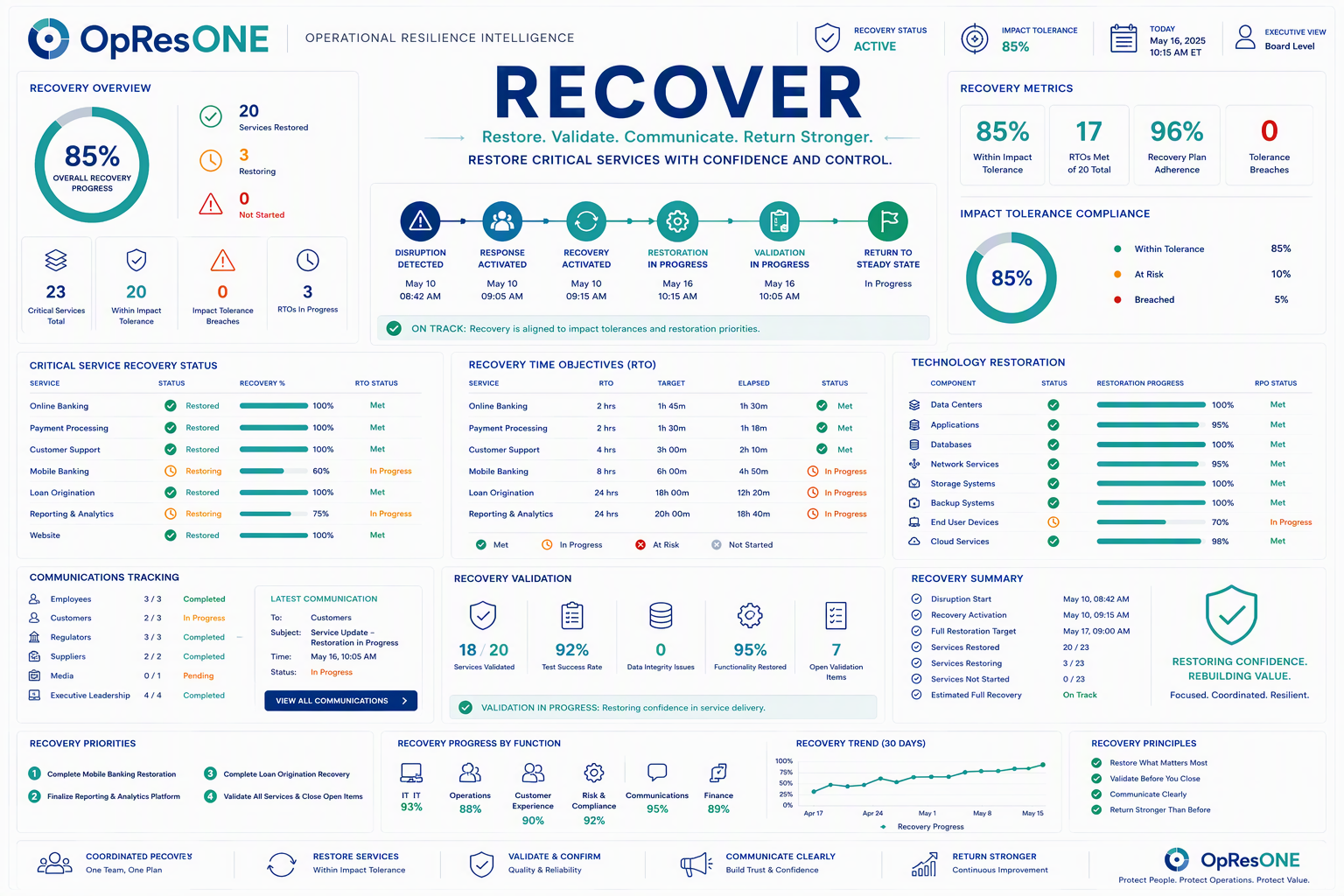
Even the most resilient organizations can experience disruptions that exceed preventative controls or operating capacity. When this happens, recovery capabilities become essential.
The Recover phase focuses on restoring critical services, business operations, technology, communications, customer outcomes, and stakeholder confidence within defined impact tolerances.
Recovery is often associated with business continuity and disaster recovery. While these disciplines remain essential, operational resilience expands recovery beyond restoring systems or relocating work. Recovery must be aligned to business priorities, customer expectations, regulatory obligations, and impact tolerance thresholds.
The Recover phase asks:
Can we restore critical services and outcomes before disruption causes unacceptable harm?
Key Inputs
The Recover phase depends on information and capabilities developed throughout the lifecycle, including:
- Business continuity plans
- Disaster recovery plans
- Critical service maps
- Recovery time objectives
- Recovery point objectives
- Impact tolerance thresholds
- Technology restoration procedures
- Application dependency maps
- Data backup and restoration procedures
- Manual workaround procedures
- Crisis communication plans
- Supplier recovery commitments
- Workforce recovery strategies
- Customer communication templates
- Regulatory notification requirements
- Incident response documentation
- Situation reports and decision logs
These inputs guide recovery sequencing, restoration priorities, communication needs, and validation activities.
Lifecycle Process
A strong recovery process ensures restoration efforts are organized, prioritized, tested, and aligned to critical outcomes.
Core recovery activities include:
-
Confirm service impact and recovery priorities
Determine which services, systems, processes, customers, and dependencies are affected. -
Align recovery to impact tolerances
Prioritize restoration based on customer harm, regulatory exposure, financial loss, operational dependency, and strategic importance. -
Activate recovery plans
Execute business continuity, disaster recovery, technology restoration, supplier recovery, facility recovery, or manual workaround procedures. -
Coordinate across business and technology teams
Ensure business operations, IT, cybersecurity, suppliers, communications, and leadership remain aligned. -
Communicate recovery status
Provide timely updates to employees, customers, executives, regulators, suppliers, and other stakeholders. -
Validate restoration
Confirm that systems, data, processes, controls, and service outcomes are functioning as required. -
Transition to steady-state operations
Move from recovery mode back to controlled operations while monitoring for residual issues.
Key Outputs
The Recover phase should produce documented and validated outputs such as:
- Recovery activation records
- Business continuity execution logs
- Disaster recovery execution logs
- Service restoration reports
- Technology recovery validation results
- Data restoration confirmation
- Customer communication updates
- Regulatory communication records
- Recovery timeline
- Impact tolerance breach analysis
- Recovery metric reports
- Residual risk assessment
- Transition to normal operations checklist
- Post-incident review package
Why This Phase Matters
Recovery is not simply returning to normal. It is restoring value, confidence, and control.
If recovery activities are not aligned to critical services, organizations may restore the wrong systems first, overlook customer impact, miss regulatory obligations, or fail to validate that service outcomes are truly restored.
Operational resilience requires recovery to be business-led, risk-informed, technology-enabled, and tolerance-driven.
OpResONE Perspective
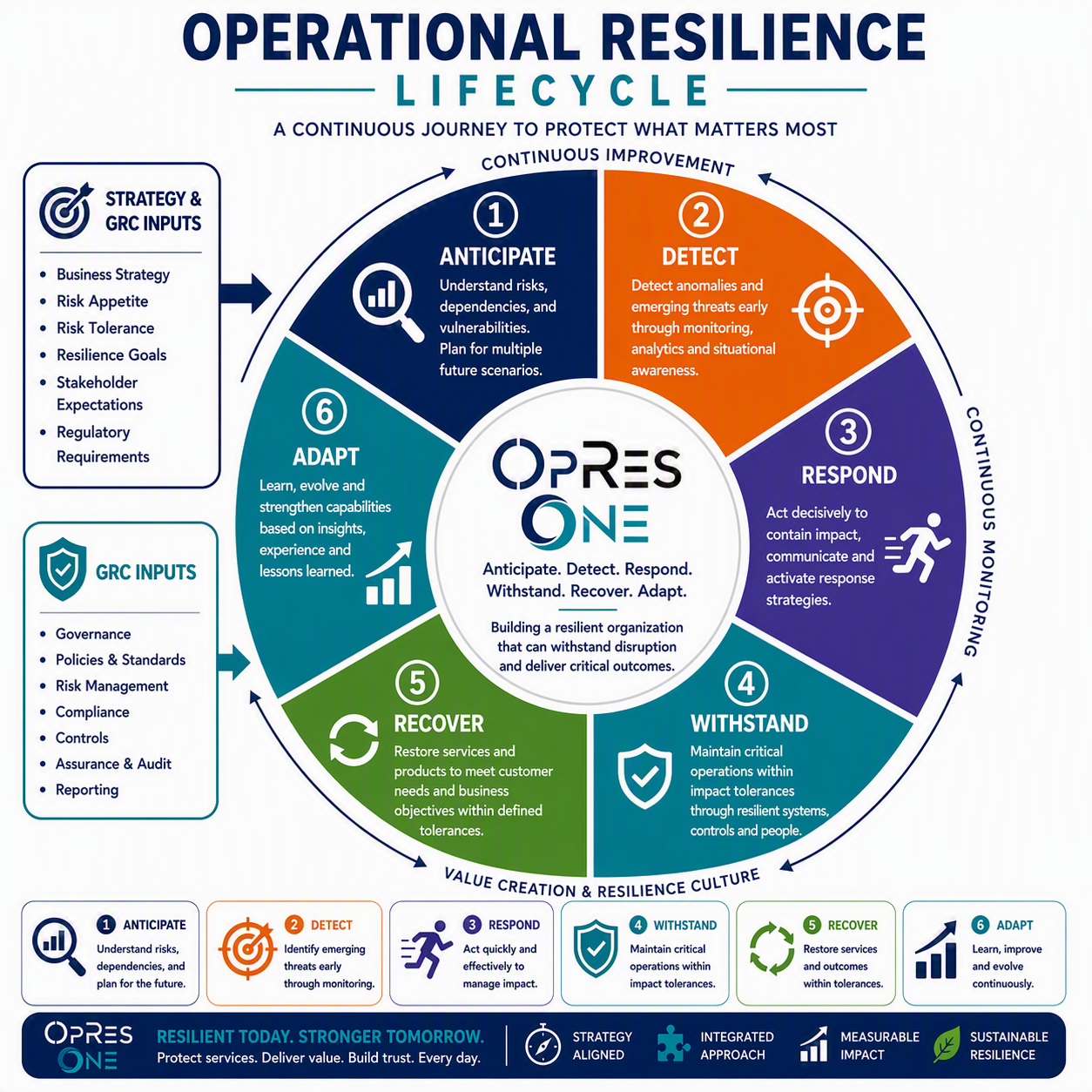
At OpResONE, we help organizations connect traditional BCM and disaster recovery capabilities to the broader operational resilience lifecycle. Recovery should not exist in isolation. It should be informed by Anticipate, triggered by Detect, coordinated through Respond, strengthened by Withstand, and improved through Adapt.
This integrated approach ensures recovery activities are not merely technical exercises, but strategic capabilities that preserve organizational value.
*Possible Integrated Dashboard
-
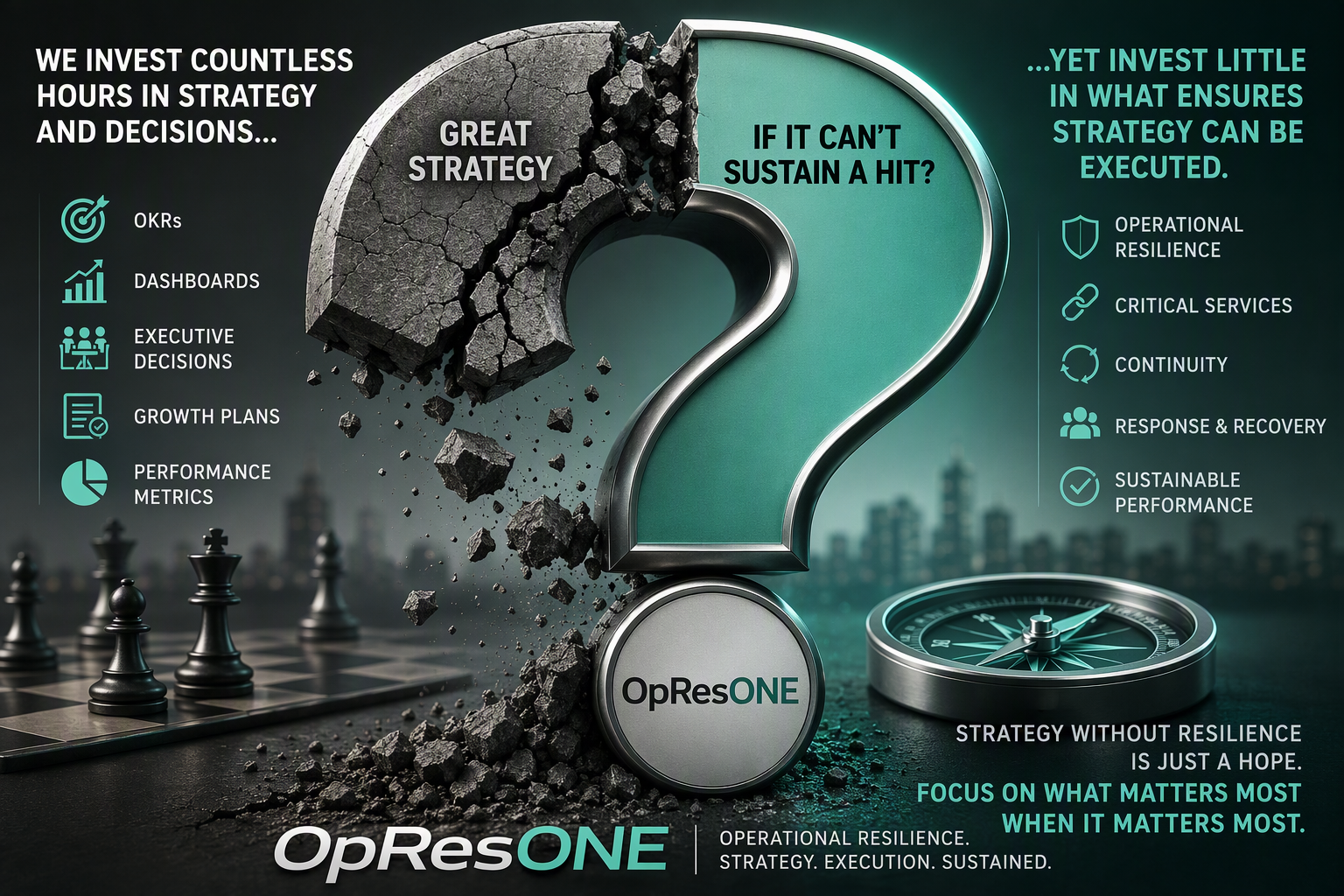
Strategy Without Resilience Is Just Hope
I continue to be surprised by how many executive teams spend countless hours debating strategy, approving growth initiatives, reviewing OKRs, monitoring dashboards, and making critical business decisions, yet invest little to no meaningful resources into ensuring that the strategy can actually be executed when disruption occurs.
Organizations will dedicate months to defining objectives, key results, performance metrics, and transformation roadmaps. They will build elaborate dashboards that show whether revenue is increasing, projects are on track, customer satisfaction is improving, and teams are meeting operational targets.
But far too often, those same organizations cannot clearly answer a much more fundamental question:
What must remain operational if the business takes a hit?
That is the question that matters.
Strategy is important. Executive decision-making is important. OKRs, KPIs, dashboards, and performance reviews all have their place. But none of them matter if the organization cannot sustain its most critical products and services during disruption.
The uncomfortable truth is that many businesses are heavily measuring performance while underinvesting in survivability.
- They know where they want to go.
- They know what they want to achieve.
- They know how they want to grow.
But they do not fully understand what must continue operating when technology fails, a supplier collapses, a cyber event occurs, a facility becomes unavailable, or a key operational dependency is suddenly disrupted.
That gap is where strategy becomes fragile.
The Problem with Repetitive BIAs
For decades, organizations have relied on Business Impact Analyses, process evaluations, recovery plans, and annual continuity reviews to define their resilience posture. While these activities have value, many organizations have fallen into a repetitive cycle of performing BIAs, documenting processes, assigning recovery time objectives, updating spreadsheets, and calling it resilience.
It is not.
- A BIA is not resilience.
- A completed process inventory is not resilience.
- A recovery plan sitting in a repository is not resilience.
- A tabletop exercise that checks a compliance box is not resilience.
Too many organizations continue to focus on the foundational process as the center of their continuity universe. They ask departments to document what they do, how they do it, what systems they use, and how long they can be down.
That information is useful, but it is not the real construct that executives should be managing.
The more important construct is the business service or product.
- Customers do not experience internal processes.
- Regulators do not evaluate organizational charts.
- Markets do not care how departments are structured.
They care whether the business can continue delivering the services and products that matter.
This is where Operational Resilience changes the conversation.
Instead of asking, “What process do we need to recover?”
Leadership should be asking:
- What critical business services must continue?
- Which products create the greatest customer, revenue, regulatory, or reputational exposure?
- What dependencies support those services and products?
- Which people, technology, suppliers, facilities, data, and third parties are required?
- What level of disruption can the organization tolerate?
- How do we know we can sustain delivery under stress?
That is a very different conversation than simply updating another BIA.
From Process Recovery to Service Resilience
A process-based view often creates fragmented continuity planning. Each department documents its own activities. Each team defines its own recovery needs. Each application owner identifies technical priorities. Each vendor risk review evaluates third-party exposure in isolation.
The result is often a collection of disconnected resilience artifacts.
But the business does not fail in departments. It fails through broken services.
A customer-facing product can collapse because of one overlooked technology dependency, one unavailable supplier, one manual workaround that does not scale, one missing data feed, or one decision point that nobody tested under pressure.
That is why resilience must be built around the services and products that create value.
When organizations shift from process evaluation to service and product resilience, they begin to see the business differently. They understand how strategic objectives are actually delivered. They see the chain of dependencies required to keep value flowing. They can identify where a single point of failure could create enterprise-wide impact.
Most importantly, they can align executive investment to what truly matters.
- Not everything deserves the same level of resilience.
- Not every process is critical.
- Not every system requires the same recovery priority.
- Not every vendor creates the same exposure.
Resilient organizations know where to focus.
The Goal Is Not to Invoke Business Continuity
Another major mindset shift is this:
The goal should not be to invoke Business Continuity.
The goal should be to build enough intelligence, foresight, and adaptive capability that the organization can avoid many disruptions before they become continuity events.
Too often, Business Continuity is treated as the response mechanism after something has already gone wrong. The plan is activated. The team mobilizes. The incident is declared. The organization shifts into recovery mode.
- But what if the organization had identified the threat earlier?
- What if leaders had seen the pattern forming?
- What if scenario-based testing had revealed the weakness before the disruption occurred?
- What if artificial intelligence, threat intelligence, supplier monitoring, operational telemetry, and risk indicators had helped the organization avoid the impact altogether?
That is where modern resilience must go.
Business Continuity remains important, but it should not be the first line of defense. It should be part of a broader resilience capability that includes anticipation, detection, response, withstand capacity, recovery, and adaptation.
The most resilient organizations are not simply better at recovering - They are better at seeing disruption coming.
AI and Intelligence as Resilience Enablers
Artificial intelligence gives organizations a powerful opportunity to move from reactive continuity planning to proactive resilience management.
AI can help identify emerging risk patterns, analyze business dependencies, detect operational anomalies, assess supplier exposure, model disruption scenarios, and support decision-making before a crisis becomes unavoidable.
Imagine using AI to evaluate:
- Which critical business services are most exposed to third-party failure
- Which processes depend on aging or fragile technology
- Which suppliers create concentration risk
- Which locations are exposed to geopolitical, weather, cyber, or infrastructure risks
- Which recovery strategies are unlikely to meet actual business tolerance
- Which disruption scenarios could create cascading impact across multiple products or services
This is where resilience becomes intelligence-led.
Leaders should not wait for an annual BIA cycle to learn where they are exposed. They should be continuously evaluating risk, dependency, capacity, and tolerance through real-time or near-real-time insight.
Scenario-based testing becomes even more powerful when supported by AI.
Instead of generic tabletop exercises, organizations can test realistic scenarios based on business services, threat landscapes, operational dependencies, and current risk signals.
That changes the value of testing.
The exercise is no longer just about whether people know the plan.
It becomes a strategic rehearsal for protecting the business.
Scenario-Based Testing Must Become Executive Muscle Memory
If strategy is important enough to debate, approve, fund, and track, then resilience is important enough to test.
Scenario-based testing should not be limited to the continuity team. It must involve business leaders, technology leaders, risk leaders, compliance leaders, operations leaders, communications teams, legal teams, suppliers, and executive decision-makers.
The best tests ask hard questions:
- What happens if the system supporting our highest revenue product is down for five days?
- What happens if a critical supplier cannot deliver?
- What happens if customer data is unavailable?
- What happens if our primary site, platform, or cloud service is inaccessible?
- What happens if a cyber event affects both production and recovery environments?
- What happens if the disruption occurs during peak business volume?
- What decisions must executives make in the first 30 minutes, first 4 hours, and first 24 hours?
These are not theoretical questions - These are business survival questions.
Scenario-based testing exposes assumptions. It reveals gaps. It challenges outdated recovery strategies. It forces leaders to confront whether their strategy can actually withstand real-world disruption.
That is a good thing.
The purpose of testing is not to prove that everything works.
The purpose of testing is to discover what does not work before customers, regulators, employees, or shareholders discover it for you.
Business Leaders Must Own the Path to Resilience
Operational Resilience cannot be delegated entirely to Business Continuity, Risk, Compliance, or IT. Those teams are critical enablers, but they are not the owners of enterprise value.
- Business leaders own the products.
- Business leaders own the services.
- Business leaders own the customer promise.
- Business leaders own the execution of strategy.
Therefore, business leaders must also own the resilience of the services and products they depend on to deliver that strategy.
This requires a different culture.
- A resilient culture does not wait for annual planning cycles.
- A resilient culture does not treat continuity as documentation.
- A resilient culture does not confuse compliance with capability.
- A resilient culture asks better questions every day:
- What is changing in our risk environment?
- What dependency could fail?
- What service would be most impacted?
- What customer outcome must we protect?
- What signal are we ignoring?
- What scenario have we not tested?
- What investment would reduce our exposure?
- What must remain operational no matter what?
When executives, business leaders, and operational teams begin asking those questions consistently, resilience becomes part of how the organization thinks.
- Not a plan.
- Not a policy.
- Not an annual exercise.
A culture.
GRC Is the Pathway to Integrate Business Continuity and Achieve Resilience
This is where Governance, Risk, and Compliance must be reframed.
GRC is not the destination.
GRC is the pathway.
Too often, organizations treat GRC as a collection of controls, policies, audits, risk registers, compliance obligations, and reporting activities. Those elements are important, but by themselves they do not create resilience. They create structure. They create visibility. They create accountability. But unless GRC is connected to Business Continuity, IT Disaster Recovery, Crisis Management, Third-Party Risk, Cyber Resilience, and operational execution, the organization is left with governance artifacts instead of operational capability.
The real value of GRC is its ability to integrate the many moving parts of the business into one connected resilience ecosystem.
- Business Continuity identifies what must continue.
- Risk Management identifies what could disrupt it.
- Compliance identifies what obligations must be met.
- IT Disaster Recovery identifies how technology must be restored.
- Third-Party Risk identifies external dependencies.
- Crisis Management identifies how leadership must make decisions under pressure.
Operational Resilience brings all of these disciplines together around the business services and products that matter most.
That integration is the difference between having isolated programs and having an enterprise resilience capability.
When GRC is properly designed, it becomes the connective tissue between strategy, risk, operations, technology, suppliers, compliance, and executive decision-making. It allows leaders to see not just whether controls exist, but whether the business can continue to deliver critical services during disruption.
A mature GRC capability should answer questions such as:
- Which critical business services support our strategy?
- What risks could disrupt those services?
- Which controls reduce the likelihood or impact of disruption?
- Which suppliers, technologies, people, facilities, and data enable delivery?
- Which regulatory obligations apply if the service is interrupted?
- Which recovery strategies have been validated?
- Which scenarios have been tested?
- Where do resilience gaps remain?
- What investments will most improve survivability?
This is the pathway from documentation to intelligence.
From compliance to confidence.
From Business Continuity planning to Operational Resilience.
Business Continuity should not sit on the side of the organization as a stand-alone program that updates plans once a year. It should be integrated directly into the GRC ecosystem so that continuity requirements, recovery capabilities, impact tolerances, dependency mapping, scenario testing, risk treatment, and executive reporting all connect back to the services and products the organization must protect.
- That is how resilience becomes measurable.
- That is how resilience becomes actionable.
- That is how resilience becomes part of executive decision-making.
GRC gives the organization the framework. Business Continuity gives the organization the response and recovery capability. Operational Resilience gives the organization the strategic outcome.
Together, they create the path to sustained performance under stress.
The organizations that understand this will stop asking whether they have completed the BIA, updated the plan, or passed the audit.
They will ask a better question: Can our most important business services continue to deliver value when disruption occurs?
That is the question GRC must help answer.
That is the role Business Continuity must help enable.
And that is the outcome Operational Resilience must achieve.
Build the Culture Today
The future belongs to organizations that can execute strategy under stress. They will truly be the competitive elephant in the room!
- Not just organizations with polished dashboards.
- Not just organizations with aggressive OKRs.
- Not just organizations with ambitious growth plans.
The organizations that will thrive are those that understand what is truly critical, invest in protecting it, use intelligence to anticipate risk, test their ability to withstand disruption, and adapt before disruption becomes failure.
That is the new executive challenge.
- Strategy must be resilient.
- Operations must be intelligent.
- Products and services must be understood end to end.
- Business leaders must be engaged.
- AI must be used proactively.
- Scenario testing must become routine.
- And Business Continuity must evolve from a reactive recovery discipline into a strategic resilience capability.
Because the ultimate measure of strategy is not how well it performs when everything is going right. The ultimate measure of strategy is whether it can still be executed when something goes wrong.
So the question for every executive team is simple:
Are you building a business that can merely perform, or are you building a business that can withstand, recover, adapt, and thrive?
Build the culture today.
Use intelligence.
Test the scenarios.
Focus on the services and products that matter most.
Avoid the disruption where possible.
Recover when necessary.
Adapt always.
And above all else:
Thrive.

Joseph Brewer, MBCP, PMP, CCMP, MBA
CEO, OpResONE, Inc.

Master Business Continuity Planner (MBCP)
ISO 22301 Certified Sr. Lead Implementer
ISO 22301 Certified Sr. Lead Auditor
ISO 31000 Certified Sr. Risk Manager
ISO 27035 Certified Sr. Lead Incident Manager
D.O.R.A. Senior Lead Manager
Senior Lead Operational Resilience Manager
ISO Certified Trainer for PECB
We bring BRILLIANCEto RESILIENCE®
-
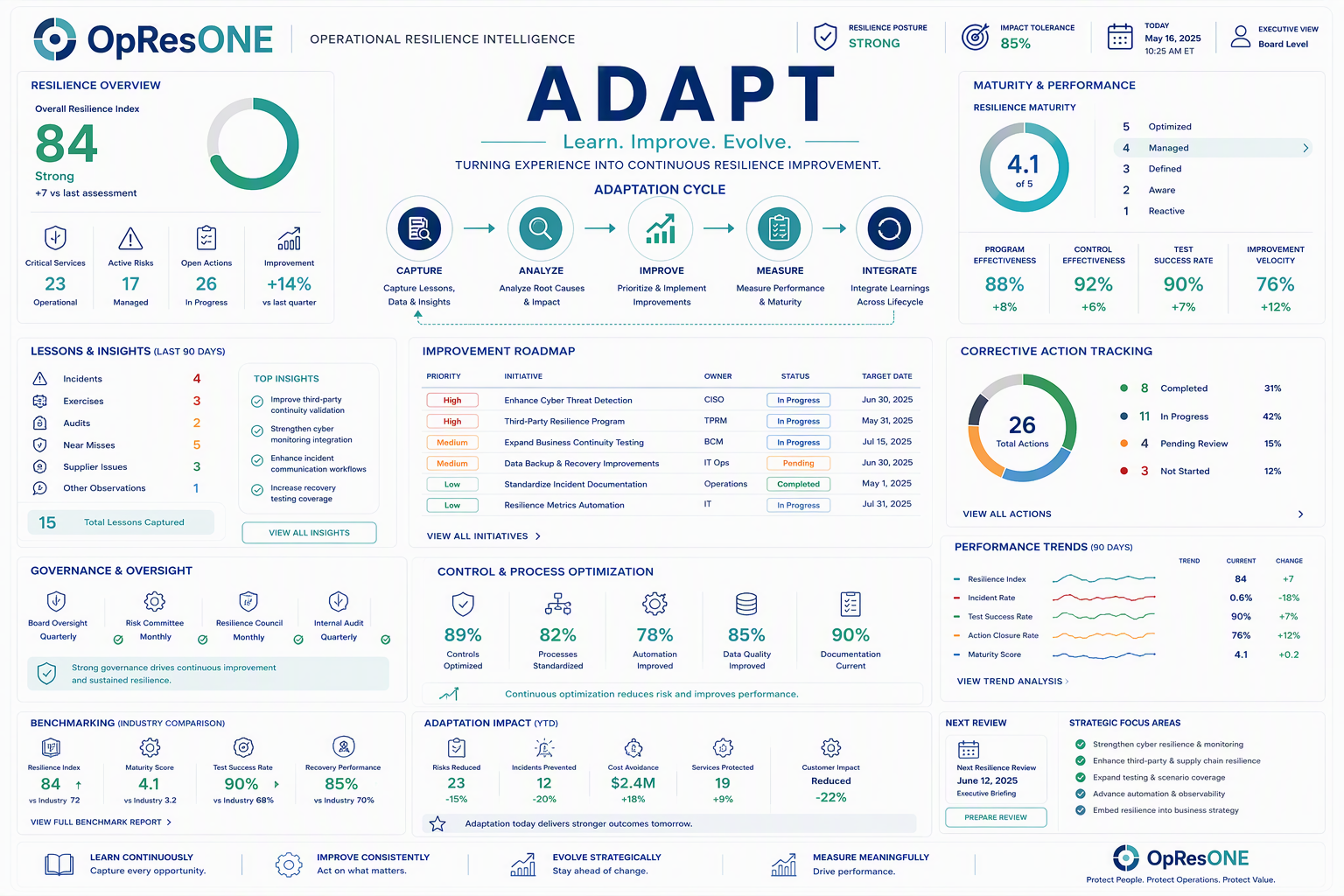
Operational resilience is never finished.
Every incident, exercise, audit, near miss, supplier issue, cyber event, technology outage, and operational challenge creates new intelligence. The question is whether the organization uses that intelligence to improve.
The Adapt phase turns experience into action. It ensures resilience remains aligned with business strategy, technology modernization, regulatory expectations, customer needs, and emerging threats.
Organizations that adapt become stronger over time. Organizations that do not adapt repeat the same failures.
The Adapt phase asks:
What did we learn, what must change, and how do we make the organization more resilient going forward?
Key Inputs
The Adapt phase relies on evidence from across the resilience lifecycle, including:
- Incident reports
- Post-incident reviews
- Lessons learned results
- Exercise findings
- Audit findings
- Control testing results
- Maturity assessments
- Performance metrics
- Impact tolerance breaches
- Recovery validation results
- Supplier performance reviews
- Cyber event analysis
- Regulatory feedback
- Customer complaints
- Risk assessments
- Executive governance decisions
- Program benchmarking results
These inputs allow the organization to identify recurring weaknesses, improvement opportunities, investment needs, and governance gaps.
Lifecycle Process
The Adapt phase creates a structured process for continuous improvement.
Core adaptation activities include:
-
Capture lessons learned
Gather insights from incidents, exercises, failed controls, near misses, audits, and operational events. -
Analyze root causes
Determine whether issues were caused by process failure, technology weakness, supplier dependency, control gaps, unclear roles, poor escalation, insufficient training, or governance failure. -
Prioritize improvements
Rank corrective actions based on risk reduction, critical service impact, regulatory importance, cost, complexity, and strategic value. -
Update resilience capabilities
Revise plans, controls, operating models, playbooks, supplier requirements, continuity strategies, monitoring indicators, and governance reporting. -
Measure progress
Track remediation, resilience maturity, control effectiveness, test performance, incident trends, and impact tolerance alignment. -
Report to leadership
Provide executive-level visibility into resilience posture, improvement progress, persistent risk, investment needs, and strategic roadmap priorities. -
Feed lessons back into the lifecycle
Ensure improvements inform the next Anticipate, Detect, Respond, Withstand, and Recover cycles.
Key Outputs
The Adapt phase should create outputs that support measurable improvement, including:
- Lessons learned report
- Root cause analysis
- Corrective action plan
- Continuous improvement roadmap
- Updated resilience maturity assessment
- Control optimization plan
- Updated business continuity plans
- Updated disaster recovery plans
- Updated incident response playbooks
- Updated supplier resilience requirements
- Updated KRIs, KPIs, and KCIs
- Governance review report
- Executive resilience performance dashboard
- Strategic resilience roadmap
- Board-level resilience briefing
Why This Phase Matters
Without adaptation, resilience programs become stale. Plans become outdated. Controls lose effectiveness. Supplier assumptions become inaccurate. Technology dependencies change. Regulations evolve. Business priorities shift.
Adaptation ensures that operational resilience remains dynamic and relevant.
This phase also helps organizations demonstrate continuous improvement to executives, regulators, auditors, customers, and stakeholders.
OpResONE Perspective
At OpResONE, we believe Adapt is where resilience becomes a true management system. It transforms operational resilience from a one-time project into an embedded, measurable, and continuously improving capability.
Adaptation connects governance, risk management, control improvement, audit remediation, technology modernization, supplier oversight, and strategic planning. It ensures the organization does not simply survive disruption, but becomes stronger because of it.
*Possible integrated dashboard