

• +1 602-922-5990
  • This email address is being protected from spambots. You need JavaScript enabled to view it.
  • Mon - Fri 8:00a - 5:00p PDT
Respond: Coordinated Action When Operational Disruption Occurs

No organization can eliminate every risk. Even with strong governance, mature controls, resilient architectures, and proactive monitoring, disruptions will still occur.

The difference between a contained incident and an organizational crisis often depends on the quality of the response.

The Respond phase focuses on how the organization acts when disruption occurs. It brings together incident response, crisis management, operational decision-making, executive leadership, communications, regulatory awareness, and business continuity coordination.

The goal is not simply to react. The goal is to preserve control, protect stakeholders, maintain confidence, and prevent operational disruption from escalating beyond acceptable tolerances.

The Respond phase asks:

When disruption occurs, can we make the right decisions quickly, communicate effectively, and coordinate action across the enterprise?


Key Inputs

Response activities depend on current, accurate, and decision-ready information, including:

  • Incident alerts
  • Detection triggers
  • Escalation criteria
  • Crisis management plans
  • Incident response plans
  • Business continuity plans
  • Cyber incident playbooks
  • Communications templates
  • Regulatory notification requirements
  • Stakeholder contact lists
  • Critical service maps
  • Impact tolerance thresholds
  • Supplier escalation contacts
  • Executive decision protocols
  • Situation reports
  • Legal and compliance guidance

These inputs help response teams understand what happened, what is affected, who needs to act, and what decisions are required.


Lifecycle Process

A mature Respond process establishes clear roles, repeatable workflows, and coordinated decision-making.

Core response activities include:

1. Recognize and Classify the Event

Determine whether the event is an operational incident, cyber event, supplier disruption, technology outage, compliance issue, crisis, or combined event.

2. Escalate Based on Impact

Use severity levels and impact tolerance thresholds to determine when leadership, crisis teams, regulators, customers, or suppliers must be engaged.

3. Activate Response Structures

Mobilize incident response teams, crisis management teams, business continuity teams, technology recovery teams, communications teams, and executive leadership as needed.

4. Develop a Common Operating Picture

Establish a shared understanding of what happened, what services are impacted, what dependencies are affected, and what actions are underway.

5. Make Timely Decisions

Enable executives and operational leaders to make informed decisions regarding service prioritization, resource allocation, customer communication, workarounds, recovery sequencing, and risk acceptance.

6. Communicate Clearly and Consistently

Coordinate internal, external, customer, supplier, regulator, media, and executive communications.

7. Track Actions and Decisions

Maintain decision logs, action registers, situation updates, and evidence for post-incident review.


Key Outputs

The Respond phase should generate structured, auditable outputs such as:

  • Incident classification record
  • Situation reports
  • Crisis management meeting records
  • Decision logs
  • Action trackers
  • Stakeholder communication notices
  • Regulatory notification records
  • Executive briefings
  • Service impact assessments
  • Escalation reports
  • Response timeline
  • Supplier coordination records
  • Customer communication updates
  • Incident containment documentation
  • Transition plan to Withstand or Recover activities

Why This Phase Matters

Poor response creates secondary damage. Confusion, delayed escalation, conflicting communication, unclear leadership, and undocumented decisions can increase operational, reputational, legal, and regulatory exposure.

A strong response capability allows organizations to act with discipline under pressure. It ensures that teams know their roles, executives receive meaningful information, customers receive appropriate communication, and critical services remain the central focus.


OpResONE Perspective

At OpResONE, we help organizations integrate crisis management, cyber incident response, business continuity, disaster recovery, supplier coordination, and executive decision-making into a single response model.

This is critical because real disruptions do not respect organizational silos. A cyber incident may become a customer service issue. A supplier failure may become a regulatory issue. A technology outage may become an executive crisis.

Operational resilience requires response structures that are integrated, practiced, and aligned to critical outcomes.

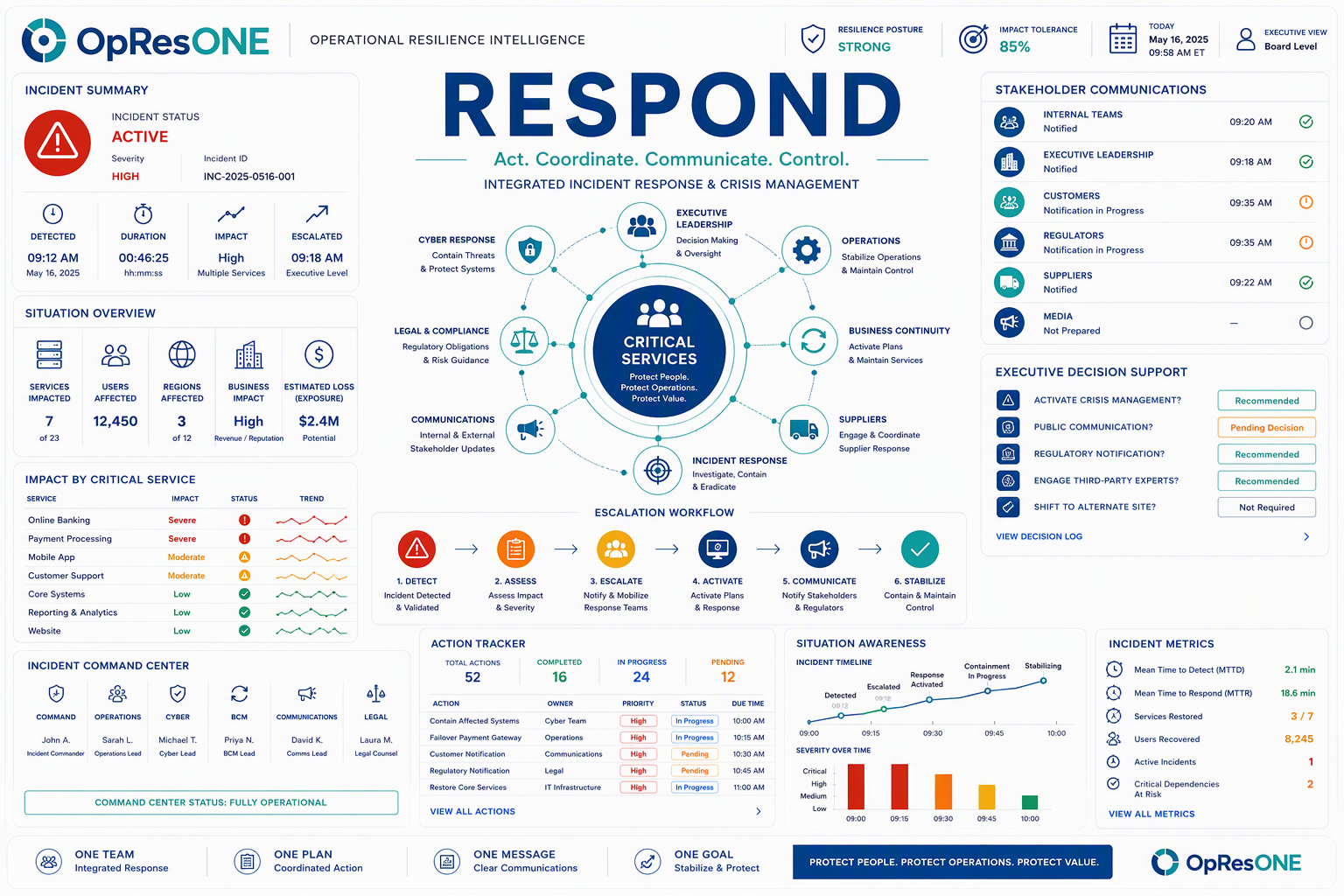
*Possible Integrated Dashboard


Operational resilience is never finished.

Every incident, exercise, audit, near miss, supplier issue, cyber event, technology outage, and operational challenge creates new intelligence. The question is whether the organization uses that intelligence to improve.

The Adapt phase turns experience into action. It ensures resilience remains aligned with business strategy, technology modernization, regulatory expectations, customer needs, and emerging threats.

Organizations that adapt become stronger over time. Organizations that do not adapt repeat the same failures.

The Adapt phase asks:

What did we learn, what must change, and how do we make the organization more resilient going forward?

Key Inputs

The Adapt phase relies on evidence from across the resilience lifecycle, including:

  • Incident reports
  • Post-incident reviews
  • Lessons learned results
  • Exercise findings
  • Audit findings
  • Control testing results
  • Maturity assessments
  • Performance metrics
  • Impact tolerance breaches
  • Recovery validation results
  • Supplier performance reviews
  • Cyber event analysis
  • Regulatory feedback
  • Customer complaints
  • Risk assessments
  • Executive governance decisions
  • Program benchmarking results

These inputs allow the organization to identify recurring weaknesses, improvement opportunities, investment needs, and governance gaps.

Lifecycle Process

The Adapt phase creates a structured process for continuous improvement.

Core adaptation activities include:

  1. Capture lessons learned
    Gather insights from incidents, exercises, failed controls, near misses, audits, and operational events.

  2. Analyze root causes
    Determine whether issues were caused by process failure, technology weakness, supplier dependency, control gaps, unclear roles, poor escalation, insufficient training, or governance failure.

  3. Prioritize improvements
    Rank corrective actions based on risk reduction, critical service impact, regulatory importance, cost, complexity, and strategic value.

  4. Update resilience capabilities
    Revise plans, controls, operating models, playbooks, supplier requirements, continuity strategies, monitoring indicators, and governance reporting.

  5. Measure progress
    Track remediation, resilience maturity, control effectiveness, test performance, incident trends, and impact tolerance alignment.

  6. Report to leadership
    Provide executive-level visibility into resilience posture, improvement progress, persistent risk, investment needs, and strategic roadmap priorities.

  7. Feed lessons back into the lifecycle
    Ensure improvements inform the next Anticipate, Detect, Respond, Withstand, and Recover cycles.

Key Outputs

The Adapt phase should create outputs that support measurable improvement, including:

  • Lessons learned report
  • Root cause analysis
  • Corrective action plan
  • Continuous improvement roadmap
  • Updated resilience maturity assessment
  • Control optimization plan
  • Updated business continuity plans
  • Updated disaster recovery plans
  • Updated incident response playbooks
  • Updated supplier resilience requirements
  • Updated KRIs, KPIs, and KCIs
  • Governance review report
  • Executive resilience performance dashboard
  • Strategic resilience roadmap
  • Board-level resilience briefing

Why This Phase Matters

Without adaptation, resilience programs become stale. Plans become outdated. Controls lose effectiveness. Supplier assumptions become inaccurate. Technology dependencies change. Regulations evolve. Business priorities shift.

Adaptation ensures that operational resilience remains dynamic and relevant.

This phase also helps organizations demonstrate continuous improvement to executives, regulators, auditors, customers, and stakeholders.

OpResONE Perspective

At OpResONE, we believe Adapt is where resilience becomes a true management system. It transforms operational resilience from a one-time project into an embedded, measurable, and continuously improving capability.

Adaptation connects governance, risk management, control improvement, audit remediation, technology modernization, supplier oversight, and strategic planning. It ensures the organization does not simply survive disruption, but becomes stronger because of it.

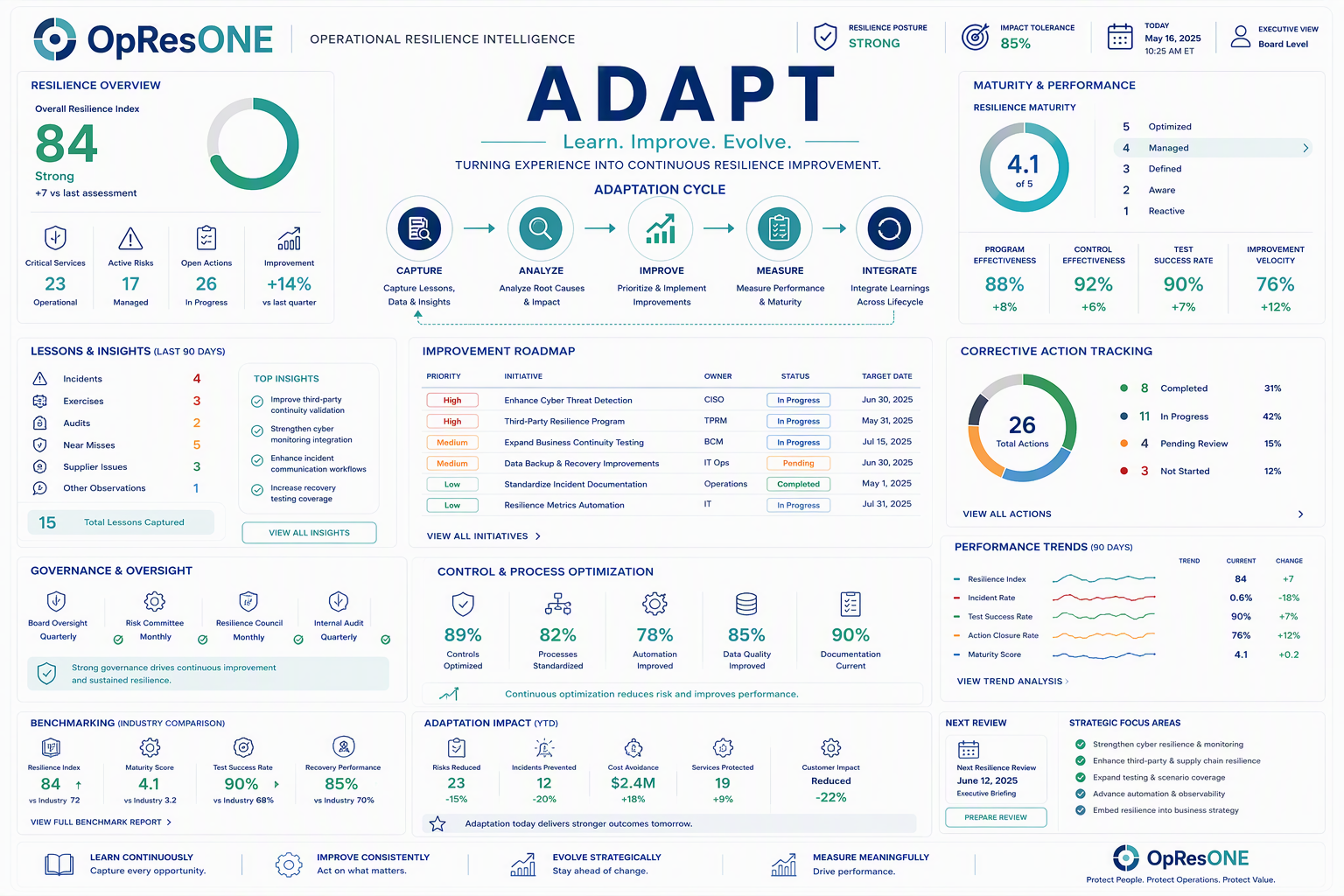
*Possible integrated dashboard


Even the most resilient organizations can experience disruptions that exceed preventative controls or operating capacity. When this happens, recovery capabilities become essential.

The Recover phase focuses on restoring critical services, business operations, technology, communications, customer outcomes, and stakeholder confidence within defined impact tolerances.

Recovery is often associated with business continuity and disaster recovery. While these disciplines remain essential, operational resilience expands recovery beyond restoring systems or relocating work. Recovery must be aligned to business priorities, customer expectations, regulatory obligations, and impact tolerance thresholds.

The Recover phase asks:

Can we restore critical services and outcomes before disruption causes unacceptable harm?

Key Inputs

The Recover phase depends on information and capabilities developed throughout the lifecycle, including:

  • Business continuity plans
  • Disaster recovery plans
  • Critical service maps
  • Recovery time objectives
  • Recovery point objectives
  • Impact tolerance thresholds
  • Technology restoration procedures
  • Application dependency maps
  • Data backup and restoration procedures
  • Manual workaround procedures
  • Crisis communication plans
  • Supplier recovery commitments
  • Workforce recovery strategies
  • Customer communication templates
  • Regulatory notification requirements
  • Incident response documentation
  • Situation reports and decision logs

These inputs guide recovery sequencing, restoration priorities, communication needs, and validation activities.

Lifecycle Process

A strong recovery process ensures restoration efforts are organized, prioritized, tested, and aligned to critical outcomes.

Core recovery activities include:

  1. Confirm service impact and recovery priorities
    Determine which services, systems, processes, customers, and dependencies are affected.

  2. Align recovery to impact tolerances
    Prioritize restoration based on customer harm, regulatory exposure, financial loss, operational dependency, and strategic importance.

  3. Activate recovery plans
    Execute business continuity, disaster recovery, technology restoration, supplier recovery, facility recovery, or manual workaround procedures.

  4. Coordinate across business and technology teams
    Ensure business operations, IT, cybersecurity, suppliers, communications, and leadership remain aligned.

  5. Communicate recovery status
    Provide timely updates to employees, customers, executives, regulators, suppliers, and other stakeholders.

  6. Validate restoration
    Confirm that systems, data, processes, controls, and service outcomes are functioning as required.

  7. Transition to steady-state operations
    Move from recovery mode back to controlled operations while monitoring for residual issues.

Key Outputs

The Recover phase should produce documented and validated outputs such as:

  • Recovery activation records
  • Business continuity execution logs
  • Disaster recovery execution logs
  • Service restoration reports
  • Technology recovery validation results
  • Data restoration confirmation
  • Customer communication updates
  • Regulatory communication records
  • Recovery timeline
  • Impact tolerance breach analysis
  • Recovery metric reports
  • Residual risk assessment
  • Transition to normal operations checklist
  • Post-incident review package

Why This Phase Matters

Recovery is not simply returning to normal. It is restoring value, confidence, and control.

If recovery activities are not aligned to critical services, organizations may restore the wrong systems first, overlook customer impact, miss regulatory obligations, or fail to validate that service outcomes are truly restored.

Operational resilience requires recovery to be business-led, risk-informed, technology-enabled, and tolerance-driven.

OpResONE Perspective

At OpResONE, we help organizations connect traditional BCM and disaster recovery capabilities to the broader operational resilience lifecycle. Recovery should not exist in isolation. It should be informed by Anticipate, triggered by Detect, coordinated through Respond, strengthened by Withstand, and improved through Adapt.

This integrated approach ensures recovery activities are not merely technical exercises, but strategic capabilities that preserve organizational value.

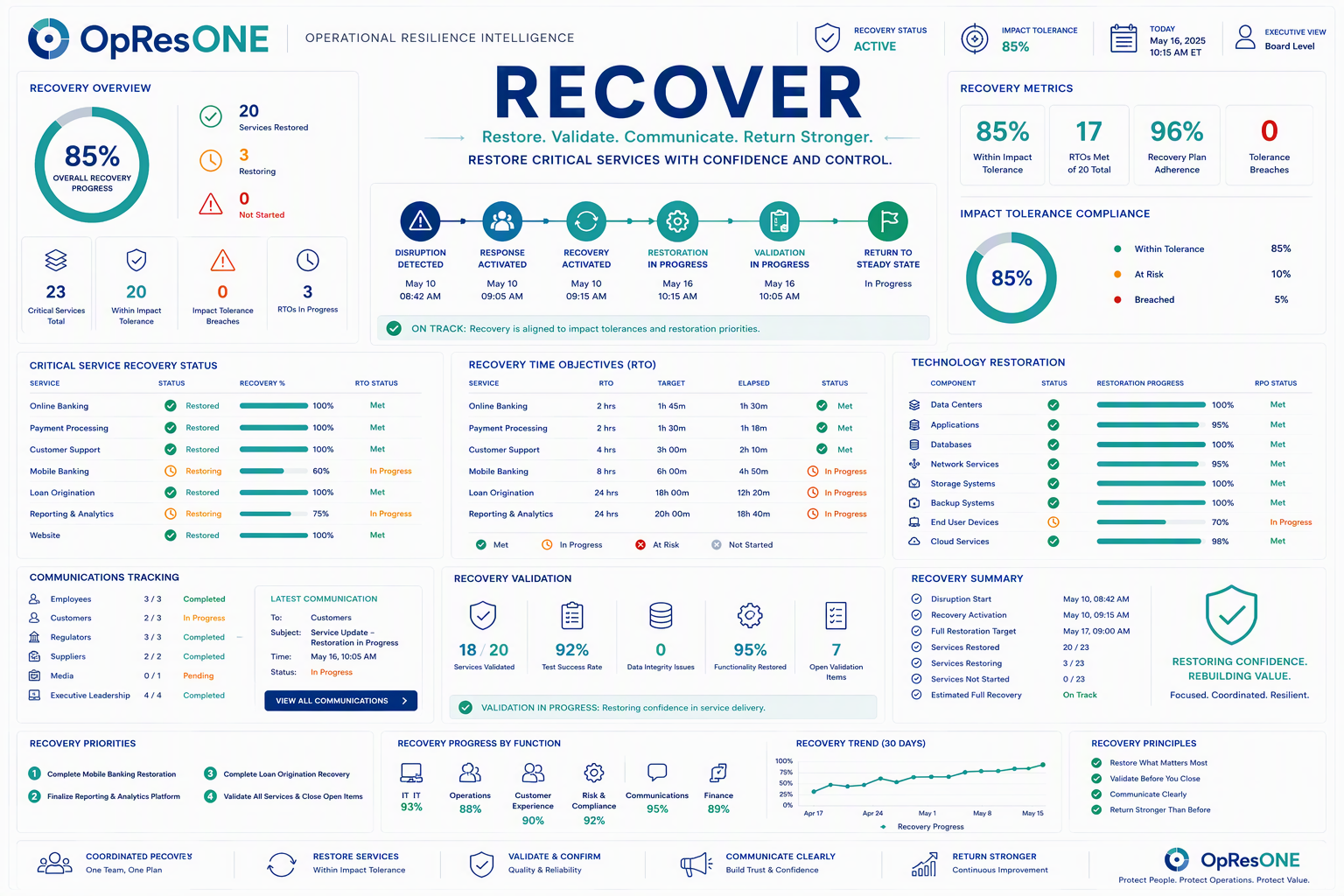
*Possible Integrated Dashboard


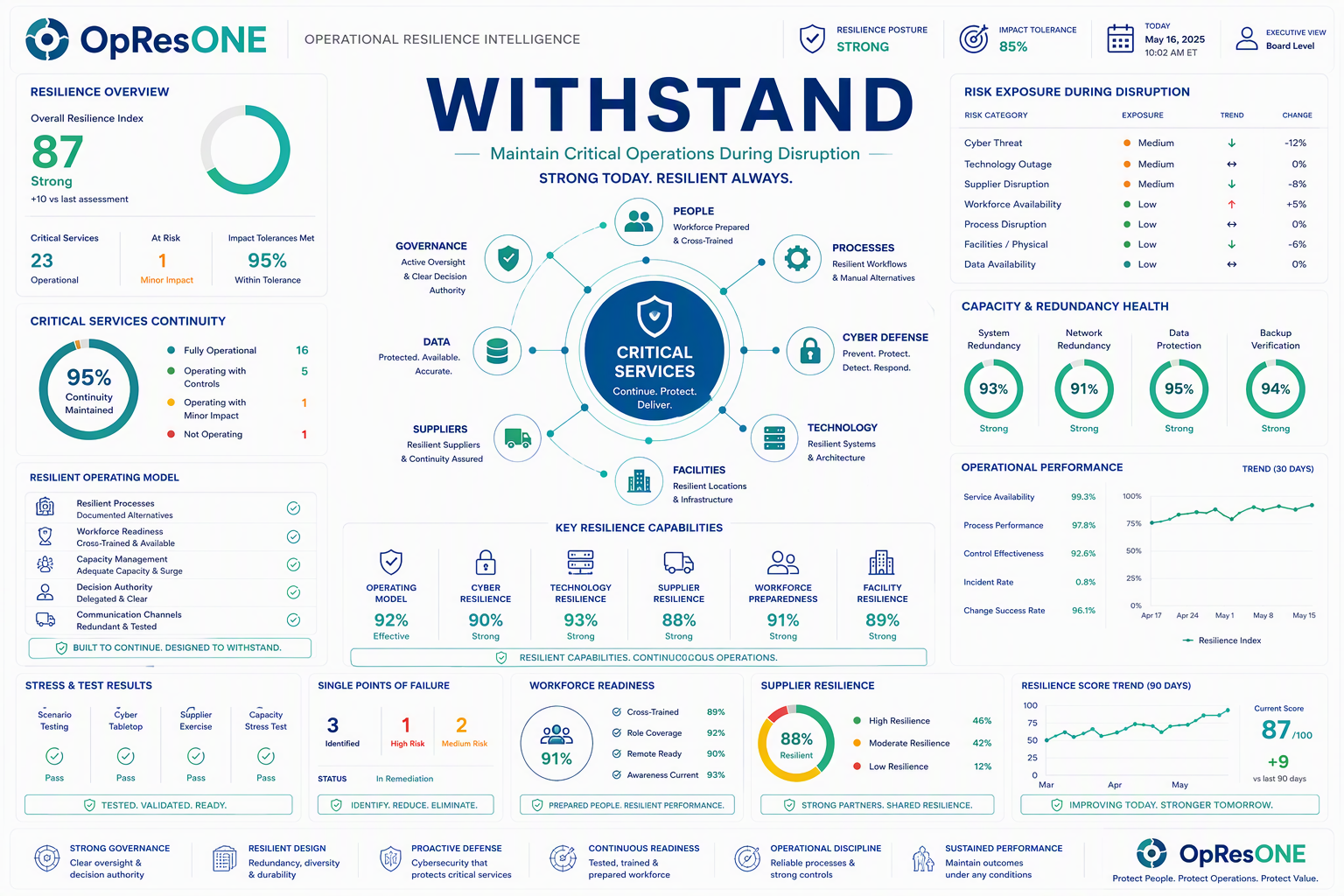
Withstand: Keeping Critical Services Operating During Disruption

Business continuity has traditionally focused on recovery. Operational resilience expands the conversation.

Instead of asking only, “How quickly can we recover?” organizations must also ask:

Can we continue delivering critical services while disruption is still happening?

That is the purpose of the Withstand phase.

Withstand focuses on the organization’s ability to absorb operational stress, continue critical service delivery, and prevent disruption from exceeding impact tolerances. It is the phase where resilience becomes embedded into operating models, technology design, supplier arrangements, workforce strategies, controls, and governance.

A resilient organization is not one that merely restores service after failure. It is one that can continue operating through disruption.

Key Inputs

The Withstand phase builds on information from Anticipate, Detect, and Respond, including:

  • Critical service maps
  • Impact tolerance statements
  • Dependency assessments
  • Control effectiveness results
  • Technology architecture reviews
  • Cybersecurity posture assessments
  • Supplier resilience assessments
  • Workforce availability plans
  • Capacity management data
  • Process-level risk assessments
  • Business continuity strategies
  • Disaster recovery capabilities
  • Incident response results
  • Operational performance monitoring
  • Risk treatment plans
  • Executive risk appetite

These inputs help determine where resilience must be strengthened to maintain operations during disruptive conditions.

Lifecycle Process

The Withstand phase focuses on designing and sustaining operational capabilities that reduce exposure and increase durability.

Core activities include:

  1. Strengthen critical service dependencies
    Improve the resilience of people, processes, technology, facilities, data, suppliers, and controls that support important services.

  2. Reduce single points of failure
    Address fragile dependencies, unsupported systems, concentrated vendor relationships, manual bottlenecks, and key-person risks.

  3. Design resilient operating models
    Embed alternate workflows, cross-training, workload shifting, remote operations, surge capacity, and decision authority into business operations.

  4. Enhance technology resilience
    Improve availability, redundancy, failover capabilities, backup architecture, cyber defenses, identity controls, data protection, and system monitoring.

  5. Improve supplier resilience
    Validate supplier continuity, concentration risk, fourth-party dependencies, service-level commitments, substitution options, and escalation protocols.

  6. Test ability to operate under stress
    Conduct scenario testing, tabletop exercises, cyber simulations, supplier disruption exercises, capacity tests, and operational stress tests.

  7. Align controls to resilience outcomes
    Evaluate whether controls are not only compliant, but effective in preserving critical service delivery during disruption.

Key Outputs

The Withstand phase should produce practical resilience-strengthening outputs such as:

  • Resilient operating model design
  • Single point of failure remediation plan
  • Service continuity strategy
  • Supplier resilience improvement plan
  • Technology resilience enhancement plan
  • Cyber resilience control map
  • Workforce resilience plan
  • Operational redundancy strategy
  • Capacity and surge plan
  • Control effectiveness report
  • Scenario testing results
  • Resilience investment roadmap
  • Executive resilience risk acceptance report

Why This Phase Matters

Withstand is where operational resilience becomes more than documentation. It becomes operational durability.

An organization may have recovery plans, but if critical services fail immediately under stress, the damage may already be done. Customers may lose access. Regulators may raise concerns. Employees may lack direction. Suppliers may fail to perform. Technology may not support alternate operations.

Withstand reduces the likelihood that disruption will become catastrophic.

OpResONE Perspective

At OpResONE, we view Withstand as one of the most important distinctions between traditional BCM and operational resilience. BCM often focuses heavily on recovering business processes after disruption. Operational resilience requires organizations to design services so they can continue operating during disruption.

This requires integration across GRC, cyber, technology, operations, third-party risk, enterprise risk, crisis management, and executive governance.

*Possible Integration Dashboard


Detect: Turning Risk Signals Into Early Warning for Operational Resilience

Traditional business continuity programs often activate after something has already gone wrong.

Operational resilience requires a more proactive approach.

The Detect phase focuses on identifying early warning signs before a risk becomes a disruption, before a disruption becomes a crisis, and before a crisis causes unacceptable harm.

Detection is about visibility. It transforms operational data, risk indicators, control results, supplier signals, performance trends, cyber alerts, and incident intelligence into actionable awareness.

In an integrated GRC framework, detection connects monitoring activities across the organization. Instead of viewing cyber alerts, supplier risks, compliance issues, operational metrics, and incident reports separately, organizations begin to understand how these signals affect critical services and strategic outcomes.

The Detect phase asks:

What is changing, deteriorating, failing, or emerging that could threaten our ability to deliver critical services?

Key Inputs

Effective detection depends on access to meaningful and timely information, including:

  • Key Risk Indicators
  • Key Performance Indicators
  • Key Control Indicators
  • Cybersecurity alerts
  • Threat intelligence feeds
  • Supplier performance metrics
  • Service-level agreement performance
  • Incident reports
  • Audit findings
  • Compliance exceptions
  • Control testing results
  • Process performance data
  • Technology monitoring data
  • Customer complaints
  • Operational loss events
  • Business continuity test results
  • Third-party risk monitoring results

These inputs help the organization identify patterns, anomalies, and emerging threats.

Lifecycle Process

The Detect phase establishes monitoring capabilities that allow leadership and operational teams to see risk movement in near real time.

A strong Detect process typically includes:

  1. Define meaningful indicators
    Establish KRIs, KPIs, KCIs, and threshold triggers aligned to critical services and impact tolerances.
  1. Monitor critical dependencies
    Track people, process, technology, supplier, facility, data, and control dependencies that support important business services.

  2. Integrate cyber and operational signals
    Connect cybersecurity events, system performance degradation, supplier disruptions, and operational incidents into a consolidated resilience view.

  3. Identify early warning thresholds
    Define when performance degradation becomes a resilience concern and when escalation is required.

  4. Automate reporting where possible
    Leverage GRC platforms, dashboards, workflow tools, and monitoring systems to reduce manual effort and improve timeliness.

  5. Escalate emerging threats
    Route risk signals to the appropriate operational, technical, risk, compliance, continuity, or executive audience.

  6. Validate signal quality
    Review false positives, missed indicators, delayed reporting, and unclear thresholds to improve detection maturity.

Key Outputs

The Detect phase should produce outputs that enable timely awareness and action, including:

  • Resilience dashboard
  • KRI and KPI register
  • Early warning indicator framework
  • Service health monitoring reports
  • Supplier monitoring alerts
  • Cyber and operational threat reports
  • Control exception reports
  • Incident trend analysis
  • Threshold breach notifications
  • Escalation reports
  • Executive resilience scorecards
  • Operational risk heat maps
  • Emerging risk register
  • Detection playbooks

Why This Phase Matters

The earlier an organization detects a threat, the more response options it has available. Early detection may allow the organization to prevent an incident, reduce impact, activate contingency procedures, notify leadership, engage suppliers, shift workloads, or preserve capacity before disruption escalates.

Without detection, organizations are forced into reactive response. They may not know a service is degrading until customers complain, regulators inquire, systems fail, or business operations are interrupted.

OpResONE Perspective

At OpResONE, we believe detection is where GRC data becomes operational intelligence. The real value of risk and compliance information is not just documentation. It is the ability to identify when risk is increasing and when intervention is required.

Detection allows organizations to move from static reporting to continuous resilience monitoring.

*Possible Dashboard Mockup